- Corporate
- Solutions
- Microsoft Solutions Overview
- Microsoft Dynamics 365 Business Central ERP Solution with Copilot Ai technology
- Microsoft Dynamics 365 – Sales (CRM)
- Microsoft Sustainability Solutions
- Microsoft Copilot Services
- Microsoft Fabric
- Microsoft Dynamics 365 Finance
- Microsoft Dynamics 365 Supply Chain Management
- Marketplace Offers
- AI Agents
- Services

Driving Business Growth and Lead Qualification with AI-Powered Assistants
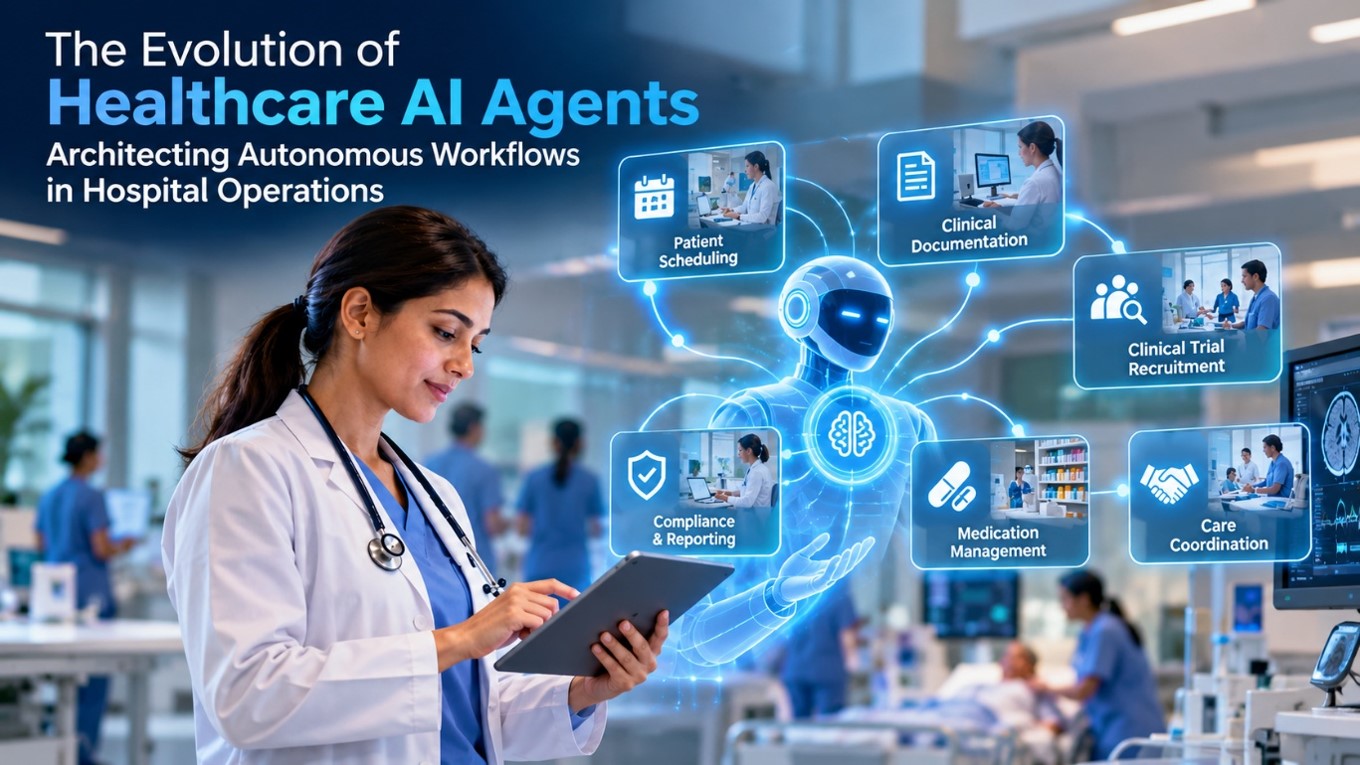
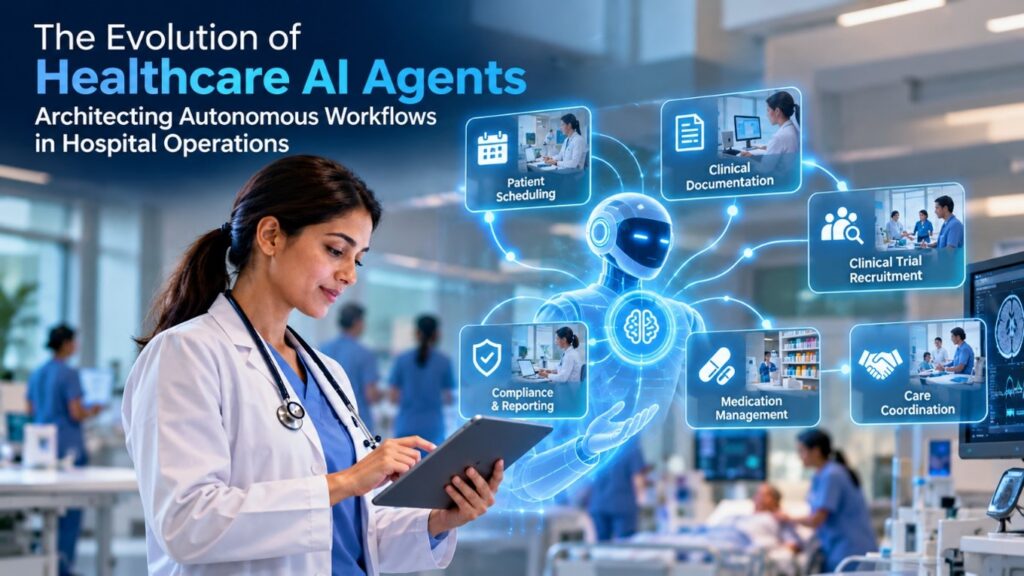
The Evolution of Healthcare AI Agents: Architecting Autonomous Workflows in Hospital Operations
The healthcare industry stands at a critical technological inflection point. For years, digital transformation in hospitals and clinical networks has been bottlenecked by fragmented legacy systems, rigid Electronic Health Record (EHR) architectures, and mounting administrative burdens that drain clinician time. While early generations of conversational bots offered basic Q&A assistance, they routinely fell short of executing complex, multi-step clinical and administrative operations.
Today, the paradigm has shifted decisively toward autonomous healthcare AI agents. Unlike static chatbots that wait for user prompts, modern enterprise AI agents act as intelligent problem-solvers capable of reasoning, executing backend tasks, verifying compliance, and orchestrating workflows across disparate hospital databases.
In this comprehensive guide, we examine the technical architecture, interoperability frameworks, and operational strategies required to build and deploy scalable AI agents in modern healthcare ecosystems.
1. The Paradigm Shift: From Copilots to Autonomous Healthcare Agents
To understand the modern healthcare automation stack, we must first differentiate between a user-facing copilot and an autonomous AI agent. A copilot functions primarily as an interactive assistant—helping a clinician draft notes or summarize patient charts on demand. An AI agent, however, takes autonomy a step further by evaluating conditions, initiating multi-system workflows, validating business rules, and executing transactions asynchronously.
For health-tech engineering teams and chief information officers (CIOs), building these intelligent workers from scratch is both cost-prohibitive and fraught with security risks. Instead, forward-thinking organizations leverage specialized enterprise platforms like Compusoft Advisors’ AI agents in Copilot Studio to rapidly prototype, customize, and deploy role-specific medical agents within secure cloud boundaries.
Key Capabilities of Modern Medical Agents:
- Asynchronous Multi-Step Execution: Handling complex requests such as coordinating cross-departmental specialist referrals without human micro-management.
- Contextual Reasoning: Interpreting unstructured clinical notes, patient intake forms, and insurance policies to extract actionable data entities.
- Deterministic Guardrails: Operating strictly within predefined compliance parameters and clinical guidelines to eliminate generative hallucinations.
2. Integrating FHIR and Real-Time Data Pipelines
An AI agent is only as effective as the data it can access. In healthcare, patient data is notoriously siloed across legacy SQL databases, departmental PACS (Picture Archiving and Communication Systems), and proprietary EHR platforms like Epic or Cerner.
To achieve real-time operational intelligence, medical AI agents must integrate natively with HL7 FHIR (Fast Healthcare Interoperability Resources) standards.
Architectural Best Practices for FHIR Integration:
1. SMART on FHIR Authentication : Implementing robust OAuth2 authorization frameworks to manage secure token exchange, enforcing strict scopes such as single-patient (launch/patient) versus population-level (user/*.rs) access.
2. Data Pre-Fetching and Caching : Mitigating API latency and EHR rate limits by caching frequently accessed reference data (such as hospital formulary lists or practitioner availability schedules) in high-performance intermediate data stores.
3. Event-Driven Architecture: Utilizing webhooks and pub/sub message brokers (such as Azure Event Hubs) to trigger agent workflows instantly when critical patient events occur, such as lab result updates or emergency admission alerts.
3. Hybrid Automation: Blending Deterministic Logic with Agentic Reasoning
Purely generative large language models are inherently probabilistic, making them risky candidates for mission-critical clinical operations where precision is paramount. Conversely, traditional rigid automation tools (like legacy RPA scripts) break down immediately when confronted with the variations inherent in unstructured medical documentation.
The solution lies in hybrid automation architecture, which combines deterministic workflow logic with non-deterministic agentic reasoning.
By routing high-risk compliance decisions through deterministic validation gates while allowing AI agents to handle natural language processing and data synthesis, healthcare providers achieve both speed and safety.
The solution lies in hybrid automation architecture, which combines deterministic workflow logic with non-deterministic agentic reasoning.
| Automation Layer | Core Technology | Primary Healthcare Use Case |
| Deterministic Layer | Rule engines, rigid API schemas, state machines | Insurance pre-authorization checks, HIPAA consent validation, medication dosage bounds verification. |
| Agentic Reasoning Layer | LLMs, vector embeddings, semantic search | Parsing messy referral letters, triaging unstructured patient messages, summarizing multidisciplinary care notes. |
4. Case Studies in Healthcare AI Agent Deployment
Hospital networks deploying custom agents typically target three high-friction operational domains: patient scheduling, clinical trial recruitment, and compliance monitoring.
A. Dynamic Patient Scheduling and Triage Traditional scheduling software relies on rigid calendars that frequently cause bottlenecks, underutilized surgical suites, and delayed care for urgent cases. Advanced Patient Scheduling Agents ingest physician availability, facility capacity, equipment sterilization timelines, and patient priority scoring in real time. When an appointment is requested, the agent evaluates clinical urgency, optimizes room allocation, and automatically coordinates pre-visit instructions with the patient.
B. Accelerating Clinical Trial Recruitment Patient recruitment remains one of the most expensive and time-consuming phases of pharmaceutical research. Clinical Research Agents ingest complex inclusion and exclusion criteria for active trials and rapidly scan incoming patient electronic health records. By processing millions of unstructured patient files securely, these agents instantly flag eligible candidates for clinical coordinators, dramatically cutting trial initiation timelines.
C. Continuous Compliance and Medical Record Auditing Maintaining constant regulatory adherence across thousands of daily medical records creates a massive administrative strain. Compliance & Reporting Agents monitor electronic health documentation continuously, flagging missing signatures, incomplete billing codes, or protocol deviations before claims submission. This proactive oversight ensures audit-ready operations and reduces revenue leakage.
5. Enterprise Governance, Security, and HIPAA Compliance
Deploying autonomous agents that interact with Protected Health Information (PHI) introduces significant regulatory and security challenges. Healthcare IT governance boards must enforce rigorous Application Lifecycle Management (ALM) and data privacy controls.
Essential Security Guardrails:
Essential Security Guardrails:
- Role-Based Access Control (RBAC) & Least-Privilege Access: Ensuring that every agent operates under strict identity permissions governed by Microsoft Entra ID (formerly Azure AD), limiting data visibility strictly to authorized personnel and operational scopes.
- Data Residency and Encryption: Guaranteeing that all patient data is encrypted both in transit (TLS 1.3) and at rest (AES-256), with regional data residency compliance enforced across cloud tenants.
- Comprehensive Audit Logging: Streaming every agent interaction, tool invocation, and decision path directly into enterprise compliance tools (such as Microsoft Purview) to maintain immutable audit trails for regulatory bodies.
Conclusion
The integration of intelligent AI agents into healthcare operations represents a fundamental evolution in how hospitals manage administrative overhead, clinical workflows, and patient experiences. Moving beyond simplistic chat interfaces, modern medical agents—powered by robust interoperability standards, hybrid automation models, and enterprise-grade security—empower healthcare systems to scale efficiently while keeping patient care at the center.
As health-tech leaders continue to modernize their digital infrastructure, adopting structured, low-code orchestration frameworks will remain the cornerstone of sustainable, secure, and future-proof medical automation.
As health-tech leaders continue to modernize their digital infrastructure, adopting structured, low-code orchestration frameworks will remain the cornerstone of sustainable, secure, and future-proof medical automation.
Recent Post
-
 06 Nov 2026From AI Conversations to Business Actions
-
 05 Nov 2026From AI Conversations to Business Actions
-
 04 Nov 2026Scaling Beyond Chatbots: Building Industry-Ready Autonomous Agents on the Microsoft Ecosystem
-
 03 Nov 2026The Evolution of Healthcare AI Agents: Architecting Autonomous Workflows in Hospital Operations
-
 30 Oct 2026Beyond Implementation: The Importance of Ongoing Support in Enterprise Microsoft Deployments
-
 28 Oct 2026How to Choose the Right Microsoft Solution Partner for Enterprise Business Apps
Grow Your Business Today
Aggarwal Estate, Chitalsar Manpada, S V Road, Thane 400 610
Microsoft Solution Partner
Quick Link