- Corporate
- Solutions
- Microsoft Solutions Overview
- Microsoft Dynamics 365 Business Central ERP Solution with Copilot Ai technology
- Microsoft Dynamics 365 – Sales (CRM)
- Microsoft Sustainability Solutions
- Microsoft Copilot Services
- Microsoft Fabric
- Microsoft Dynamics 365 Finance
- Microsoft Dynamics 365 Supply Chain Management
- Marketplace Offers
- AI Agents
- Services

Driving Business Growth and Lead Qualification with AI-Powered Assistants
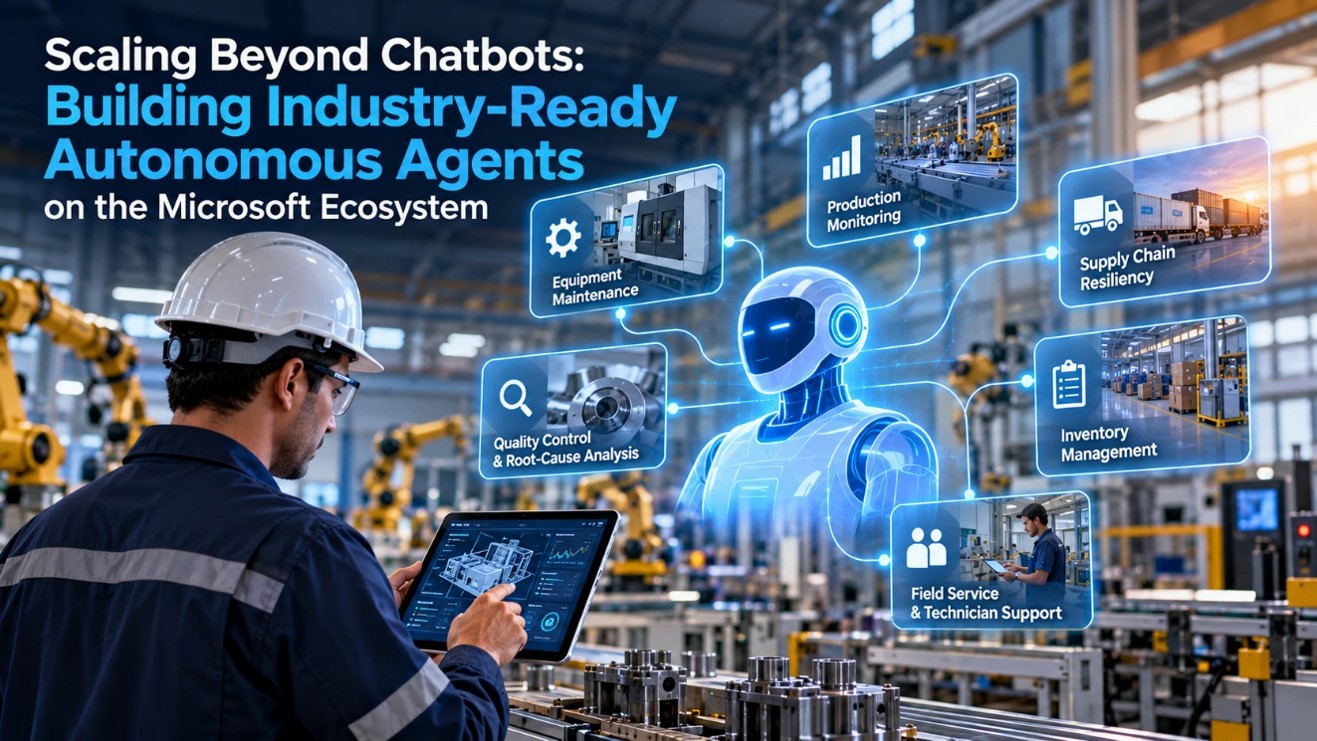
Scaling Beyond Chatbots: Building Industry-Ready Autonomous Agents on the Microsoft Ecosystem
For decades, the manufacturing sector has pursued operational excellence through digitization. From Enterprise Resource Planning (ERP) systems to Internet of Things (IoT) sensors gathering thousands of telemetry points per second, factories generate more data today than ever before. Yet, a persistent bottleneck remains: bridging the gap between raw data collection and autonomous, cross-functional execution. For years, organizations relied on rigid, rule-based chatbots to handle basic inquiries. These legacy systems served as digital receptionists, capable of answering static FAQs but utterly unequipped to handle complex, multi-step industrial workflows.
Today, the manufacturing paradigm is shifting dramatically. Chief Technology Officers and plant operations leaders are moving past superficial conversational interfaces to embrace cognitive, multi-step agentic systems. By deploying specialized AI Agents in Copilot Studio enterprises can orchestrate complex enterprise processes—ranging from automated CNC machine recalibration to real-time supply chain rerouting—without writing sprawling custom codebases from scratch. This article explores how manufacturers can scale beyond basic chatbots, leveraging the robust enterprise architecture of the Microsoft ecosystem to build resilient, intelligent autonomous agents.
The Limitations of Legacy Chatbots in Heavy Industries
To understand the necessity of autonomous agents, we must first examine why traditional chatbots failed on the factory floor. Legacy bots were built on deterministic decision trees. If a user asked a predefined question matching a brittle intent string, the bot returned a scripted answer. In administrative settings, this limitation was frustrating; in manufacturing environments, it rendered chatbots entirely useless.
Consider a scenario where a floor supervisor notices an anomalous vibration signature on a high-speed stamping press. A legacy chatbot would offer a generic help document or prompt the user to submit an IT ticket. It cannot ingest real-time sensor streams, query the maintenance management system for historical part failures, evaluate technician availability, and automatically generate an urgent work order with high-priority parts requisitioned. Industrial operations demand systems that possess situational awareness, reasoning capabilities, and direct tool execution permissions. Autonomous agents bridge this exact gap by moving from static information retrieval to dynamic, goal-directed task execution.
The Anatomy of an Enterprise-Grade Autonomous Agent
Unlike standard conversational assistants, an industry-ready autonomous agent operates as an intelligent orchestrator. It consists of four core architectural pillars designed for heavy industrial environments:
Contextual Grounding and Knowledge Retrieval: Industrial agents cannot hallucinate standard operating procedures or safety protocols. They require rigorous Retrieval-Augmented Generation (RAG) pipelines connected directly to enterprise document repositories, CAD drawings, compliance manuals, and maintenance logs.
Multi-Step Reasoning and Planning: Complex industrial problems rarely have single-turn solutions. An autonomous agent must decompose a high-level goal—such as ‘investigate line 4 bottleneck’—into sequential sub-tasks: querying the SCADA system for throughput rates, checking ERP inventory for raw material bottlenecks, and notifying shift managers via Microsoft Teams.
Tool Execution and API Integration: Agents must act upon the enterprise stack. By interfacing securely with REST APIs, SQL databases, and event-driven message brokers, agents execute verified transactions across SAP, Oracle, or Dynamics 365 without manual intervention.
Human-in-the-Loop (HITL) Safeguards: In manufacturing, autonomy must never bypass safety. Enterprise-grade frameworks enforce strict guardrails, requiring human sign-off for critical actions such as altering PLC parameters or issuing high-value purchase orders.
Leveraging the Microsoft Ecosystem for Industrial Intelligence
Building industrial-grade AI agents from scratch requires immense engineering overhead, security hardening, and infrastructure maintenance. This is why leading manufacturers increasingly anchor their agentic strategies within the Microsoft ecosystem. By combining Azure AI, the Power Platform, and Dynamics 365, organizations inherit a secure, enterprise-compliant foundation designed for industrial scalability.
Azure AI and Azure OpenAI Service provide the foundational Large Language Models (LLMs) and cognitive vision services necessary to parse complex technical manuals, interpret equipment telemetry charts, and process unstructured engineering specifications with enterprise-grade data privacy. Simultaneously, the Power Platform and Dataverse act as the integration backbone. With hundreds of pre-built connectors to manufacturing execution systems (MES), programmable logic controllers (PLCs), and cloud storage, the Power Platform allows domain experts to configure robust data flows without extensive coding.
Finally, Dynamics 365 Supply Chain Management and Field Service serve as the operational bedrock where agents update inventory ledgers, schedule mobile technicians, and track asset lifecycles in real time. This unified ecosystem eliminates data silos, ensuring that every agent operates with single-source-of-truth accuracy.
Core Manufacturing Use Cases in Action
How do these architectural layers translate to tangible shop-floor ROI? Let’s examine three primary operational use cases where autonomous agents drive measurable impact:
Automated Quality Control and Defect Root-Cause Analysis: When computer vision systems flag a surface anomaly on an automotive chassis component, an autonomous agent immediately correlates the defect timestamp with IoT temperature logs from the welding station. It queries historical maintenance records, identifies a degrading thermal sensor, and opens an immediate engineering ticket.
Dynamic Supply Chain Resiliency: Global supply chains are inherently volatile. When a critical fastener shipment is delayed at port, a supply chain agent scans alternative approved vendors, evaluates lead times and unit costs against budget constraints, and drafts a purchase order adjustment for procurement team approval within seconds.
Intelligent Shop-Floor Troubleshooting: Maintenance technicians frequently spend hours scouring dense equipment manuals during unexpected stoppages. An integrated Copilot agent allows technicians to converse naturally with machinery documentation, instantly retrieving precise wiring schematics, torque specifications, and step-by-step disassembly instructions.
Governance, Security, and Enterprise Architecture Best Practices
Deploying autonomous agents across distributed manufacturing facilities introduces distinct governance challenges. CTOs must establish rigorous protocols to ensure data integrity, operational safety, and regulatory compliance across all digital touchpoints.
First, Role-Based Access Control (RBAC) is non-negotiable. Agents must operate under strict permission boundaries. A shop-floor operator agent should not possess permissions to modify enterprise financial ledgers or alter executive-level ERP parameters. Second, audit logging and explainability are paramount. Every decision path taken by an autonomous agent—such as why a particular supplier was recommended or why a maintenance alert was triggered—must be fully logged and auditable for root-cause analysis and regulatory compliance (ISO standards, OSHA safety audits).
Third, manufacturers should adopt a crawl-walk-run deployment strategy. Start with read-only advisory agents that assist human operators before gradually granting transactional permissions for automated procurement, work order generation, and equipment adjustment.
Conclusion
The transition from legacy chatbots to enterprise-grade autonomous agents represents a fundamental maturation in industrial digital transformation. Manufacturers can no longer afford isolated data silos and manual, swivel-chair processes. By building scalable, secure agentic architectures on trusted enterprise platforms, industrial leaders can unlock unprecedented agility, minimize unplanned downtime, and future-proof their operations.
The future of manufacturing belongs not to those who merely collect data, but to those who deploy autonomous systems capable of acting on it with precision, speed, and intelligence.
The future of manufacturing belongs not to those who merely collect data, but to those who deploy autonomous systems capable of acting on it with precision, speed, and intelligence.
Recent Post
-
 06 Nov 2026From AI Conversations to Business Actions
-
 05 Nov 2026From AI Conversations to Business Actions
-
 04 Nov 2026Scaling Beyond Chatbots: Building Industry-Ready Autonomous Agents on the Microsoft Ecosystem
-
 03 Nov 2026The Evolution of Healthcare AI Agents: Architecting Autonomous Workflows in Hospital Operations
-
 30 Oct 2026Beyond Implementation: The Importance of Ongoing Support in Enterprise Microsoft Deployments
-
 28 Oct 2026How to Choose the Right Microsoft Solution Partner for Enterprise Business Apps
Grow Your Business Today
Aggarwal Estate, Chitalsar Manpada, S V Road, Thane 400 610
Microsoft Solution Partner
Quick Link