- Corporate
- Solutions
- Microsoft Solutions Overview
- Microsoft Dynamics 365 Business Central ERP Solution with Copilot Ai technology
- Microsoft Dynamics 365 – Sales (CRM)
- Microsoft Sustainability Solutions
- Microsoft Copilot Services
- Microsoft Fabric
- Microsoft Dynamics 365 Finance
- Microsoft Dynamics 365 Supply Chain Management
- Marketplace Offers
- AI Agents
- Services

Blog
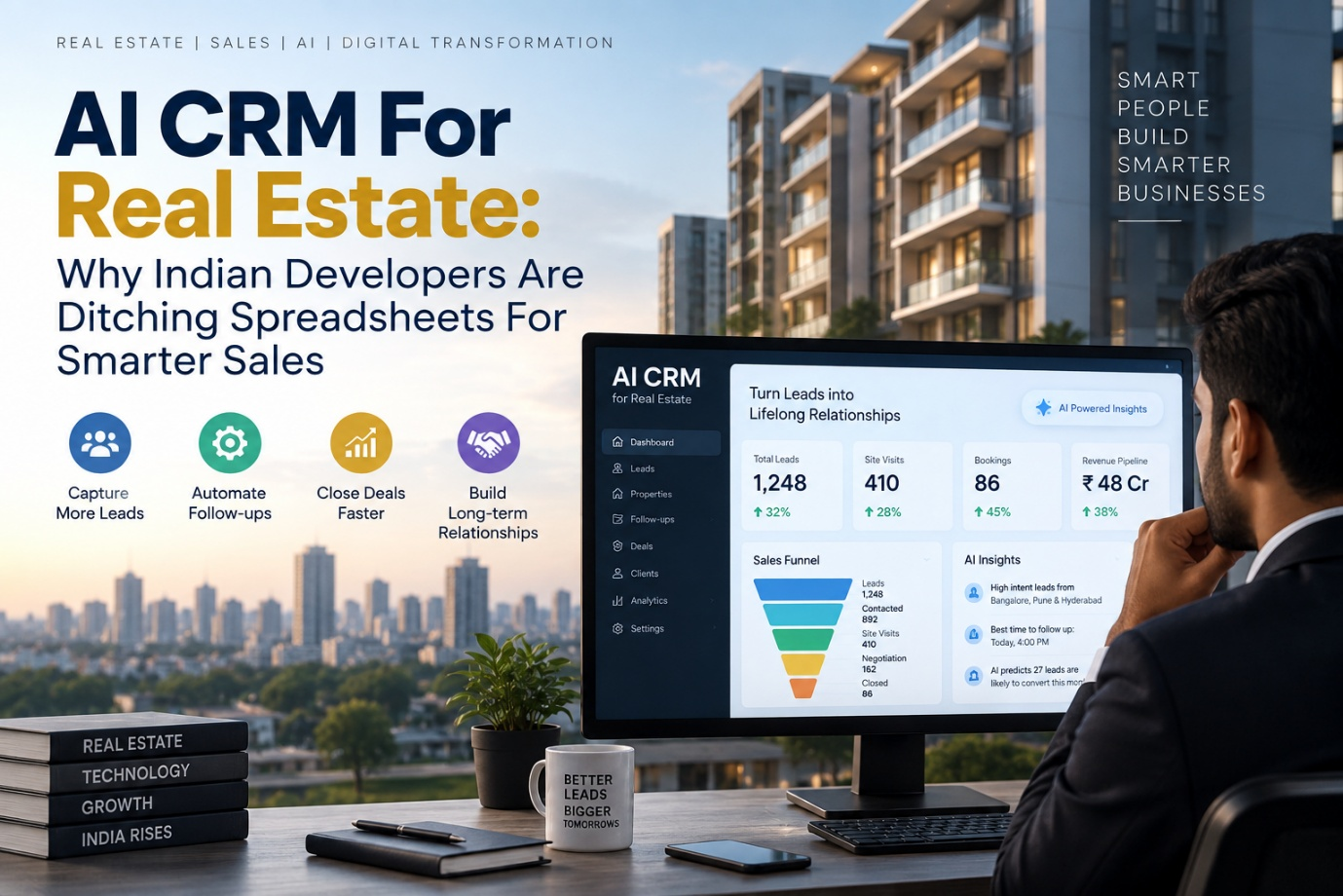
AI CRM FOR REAL ESTATE: WHY INDIAN DEVELOPERS ARE DITCHING SPREADSHEETS FOR SMARTER SALES
If you’re a developer juggling site visits in Excel, follow-ups on WhatsApp, and inventory status in someone’s head — you don’t need a new sales team. You need an AI CRM for real estate. A dedicated system built for the property sector connects your enquiries, site inventory, sales stages, and post-sales service into one place, and uses AI to do the follow-up chasing, lead scoring, and document generation for you.
That’s the short answer. Now let’s get into why generic CRM for real estate developers fails, what a purpose-built builder CRM software actually does differently, and how an AI-powered property CRM like Buildex (built on Microsoft Dynamics 365) changes the daily grind for sales and site teams alike.
Why Generic CRM Tools Don't Work For Real Estate
Most CRMs are built for one thing: managing a sales pipeline. Real estate isn’t one pipeline. It’s five or six running at once.
You’ve got:
- Pre-launch enquiries from digital campaigns
- Site visit scheduling and broker coordination
- Unit-level inventory that changes hourly
- Post-booking documentation and payment plans
- Construction milestone updates that customers demand to see
- Facility handover and post-sales service requests
A generic sales CRM tracks a deal from “lead” to “won.” It has no concept of a 3BHK on the 14th floor, a broker commission split, or a concrete pouring schedule. That’s the gap. Developers end up bolting together spreadsheets, WhatsApp groups, and a basic CRM — and none of it talks to the other.
What A Builder CRM Software Should Actually Do
A CRM built for real estate developers isn’t a rebadged sales tool. It’s software that understands the property sale as a long, multi-touch relationship — from the first enquiry to years of post-sales service.
Unified Enquiry And Sales Management
Every enquiry — website form, Facebook ad, referral, walk-in — lands in one system. No more losing a lead because it came in on a personal WhatsApp number and never made it into the tracker. Follow-ups, sales stage movement, and document generation get automated, so a hot lead isn’t sitting untouched for three days because your sales exec was at a site visit.
Unit Mapping And Live Inventory
Buyers ask the same question a hundred times a day: “Is this unit still available?” A real estate-specific CRM maps every unit, tower, and floor, and updates availability in real time. Your sales team stops overselling the same flat to two families and stops sounding uncertain on a call.
Streamlined Post-Sales Experience
The sale closing isn’t the end of the relationship — it’s the start of the longest part of it. Agreements, payment plan tracking, construction updates, and service requests need to run through the same system that closed the deal, ideally integrated with your ERP and finance stack. Otherwise your accounts team and sales team are working off two different versions of the truth.
Marketing Automation That Actually Converts
Running an email blast isn’t marketing automation. A proper builder CRM lets you run targeted WhatsApp, SMS, email, and social campaigns tied to specific projects or unit types, and shows you which campaign actually produced a site visit — not just a click.
Mobile Access For On-Ground Teams
Your sales staff aren’t sitting at a desk. They’re at the site, in traffic, or in a broker’s office. A CRM that only works on a laptop is a CRM half your team can’t use. Mobile access — with offline capability — means a site executive can pull up unit status or update a lead status standing on the construction site itself.
Where AI Actually Changes The Game
“AI-powered” gets thrown around loosely. Here’s what it means when it’s built specifically for property sales and construction, not adapted from a generic sales playbook.
AI-Based Lead Qualification
Not every enquiry deserves the same attention. Predictive scoring models rank leads by likelihood to convert, so your sales team spends time on the buyer who’s ready to book, not the one who filled a form out of curiosity six months ago.
Virtual Assistants That Never Sleep
A buyer browsing your project site at 11 PM shouldn’t wait until 10 AM for a reply. AI-powered bots handle enquiries over WhatsApp, web chat, email, or phone around the clock, capturing intent and routing serious leads to a human the next morning.
Smart Document Automation
Contracts, payment receipts, and construction schedules generated straight from system data — not typed up manually by someone cross-checking three spreadsheets. Faster turnaround, fewer errors, and a buyer who isn’t chasing your office for a document that should’ve taken five minutes.
Real-Time Construction Updates
Buyers today expect to see progress, not just hear about it. AI-generated alerts notify customers automatically when a milestone hits — slab cast, plastering complete, possession date confirmed — without your team manually drafting an update for every buyer on every project.
Purpose-Built AI Agents For The Build Side
This is where an AI-powered property CRM goes beyond sales into the construction process itself:
- Site Evaluation & Feasibility AI Agent — assesses land, cost, and compliance before you commit capital to a project
- Smart Concrete Scheduling AI Agent — automates pour schedules to cut waste and avoid delays
- Labour & Equipment Optimisation AI Agent — allocates workforce and machinery based on actual site demand
- Facility Management AI Agent — handles maintenance, compliance, and energy efficiency after handover
None of this is generic CRM territory. It’s what happens when the software is built by people who understand that a developer’s business doesn’t stop at “deal closed.”
The Real Cost Of Staying Disconnected
Ask any sales head at a mid-sized developer what keeps them up at night, and it’s rarely “not enough leads.” It’s usually:
- Leads going cold because follow-up happened two days late
- A broker selling a unit that was already booked, because inventory wasn’t updated
- A buyer calling the office three times for a document that should’ve been auto-generated
- No visibility into which marketing spend is actually producing site visits, versus vanity impressions
- Sales staff who can’t function without a laptop and a stable connection
Every one of these is a process failure, not a people failure. And every one of them is exactly what a purpose-built real estate CRM with AI agents is designed to close.
What To Look For Before You Choose One
Before you sign up for any AI CRM for real estate, check for these non-negotiables:
- Built on a platform with real ERP integration — your finance, sales, and post-sales data need to sit in one ecosystem, not three disconnected tools
- Industry-specific structure — unit mapping, broker management, and campaign tracking should be native, not custom-built add-ons
- Genuine AI, not a chatbot skin — lead scoring, document automation, and construction-side AI agents, not just a “smart” label on old software
- Mobile-first for site teams — offline capability matters more than a fancy dashboard nobody in the field will open
- Proven in Indian real estate conditions — long sales cycles, broker-driven leads, and RERA-linked documentation aren’t edge cases here, they’re the default
Get This Working For Your Projects
Buildex, built on Microsoft Dynamics 365, was designed specifically for developers, builders, and construction firms who are tired of running their business across five disconnected tools. From first enquiry to facility handover, it’s one system — with AI agents handling everything from lead qualification to concrete scheduling.
Talk to the Compusoft Advisors team and see how Buildex fits into your existing sales and construction workflow. Explore the Real Estate Solution or reach out directly at info@compusoftadvisors.com to book a walkthrough.
Recent Post
-
 17 Sep 2026How AI Agents Are Transforming Corporate Expense Management & Stopping Fraud
 -
 11 Sep 2026COMPUSOFT ADVISORS INDIA | MICROSOFT 365 COPILOT BUSINESS TRIAL: A 30-DAY GUIDE FOR BUSINESSES
 -
 10 Sep 2026AI CRM FOR REAL ESTATE: WHY INDIAN DEVELOPERS ARE DITCHING SPREADSHEETS FOR SMARTER SALES
 -
 24 Jun 2024HOW AI-DRIVEN TECHNOLOGY CHATBOTS ARE BECOMING MORE AND MORE MEANINGFUL TO BRANDS?
 -
 24 Jun 2024COMPUSOFT ADVISORS ANNOUNCED AS A WINNER IN THE 2019 IAMCP GLOBAL PARTNER-TO-PARTNER AWARDS PROGRAM
 -
 24 Jun 2024AI POWERED OMNI CHANNEL BOT PLATFORM DRIVES BETTER CUSTOMER ENGAGEMENT FOR BFSI SECTORS.
Grow Your Business Today
Aggarwal Estate, Chitalsar Manpada, S V Road, Thane 400 610
Microsoft Solution Partner
Quick Link